Written by Sofia Najera
For as long as I can remember, I’ve always wanted to be a film major. Like the average film buff, I’d kept up with every award show, the latest Nolan releases, and the news on today’s stars. As much as I prided myself on being a part of this world of cinema, I absolutely refused to watch The Godfather (Dir. Francis Ford Coppola, 1972). I was so adamant on assuming that it was just another old, overrated film…boy, was I wrong.
Cut to: a boring summer day. I’m staring at the TV trying to figure out what to watch, and lo and behold The Godfather appears on my mindless scroll. I stare at it for a good minute, my step-dad has mentioned it recently as one of his all time favorites. I’ve exhausted all my favorite films at this point and there’s nothing on my watchlist that’s jumping out at me. With a shrug, I select it and I’m off to a three hour exploration of an alleged film classic.
Who knew that watching The Godfather on a random summer day would unlock an appreciation for Italian Mafia Cinema. Since that day, I have become enamored with this world of violence and drama. Maybe it has something to do with me starting my Duolingo Italian streak at around the same time, but–in classic film bro manner–I must admit that they are genuinely amazing films.
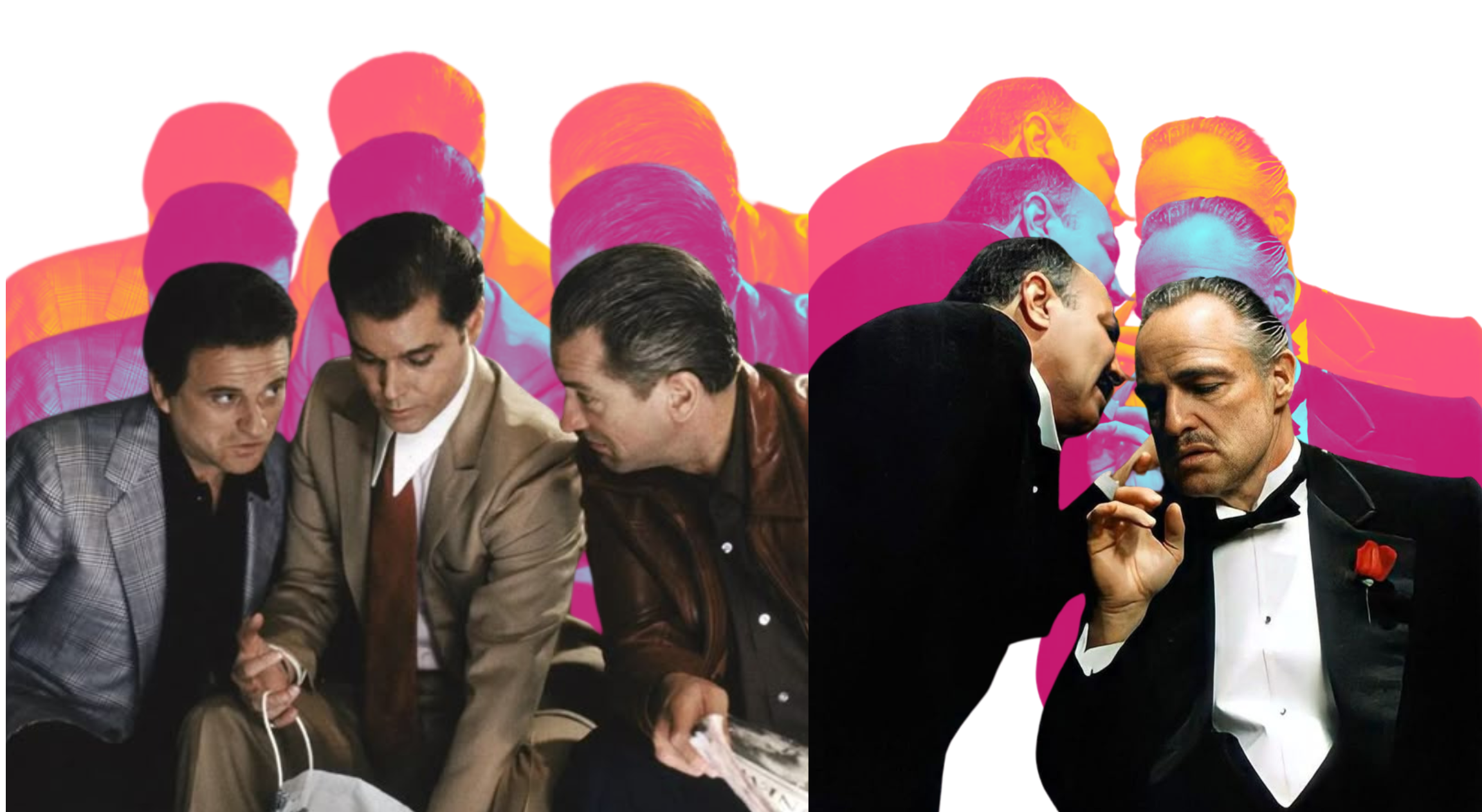
If you want to indulge in my big three of Italian Mafia Films, I’d recommend: The Godfather, Goodfellas (Dir. Martin Scorsese, 1990), and Casino (Dir. Martin Scorsese 1995) (honorable mention The Godfather Part II). The Godfather series specifically has become my family’s Diehard (Dir. John McTiernan, 1988), and I couldn’t be happier to live up to the film major reputation; the memories tied to these films override any stereotype that surrounds them.
But there’s a nitty gritty as to why these films remain such classics as well. Coppola and Scorsese are behind most of these works, which is part of why the films get so much fame. Their distinct styles and very obvious appreciation for filmmaking itself shines through every moment of these films.
Yes, the films were revolutionary in their own time for cinematography, editing, etc., but they have a certain look to them that the films of today cannot recreate. The distinct look of dim lighting on film, the jarring freeze frames and echoing sound of bullets all come together to create a period piece within itself. The films feel so distinctly ‘60s or ‘70s that you as a viewer have the opportunity to get lost in them. It’s a certain inexplicable quality that is lost in today’s digital age. Not even The Irishman (Dir. Martin Scorsese, 2019) can capture this exact feeling.
There is always something new to be discovered in filmmaking, but there was a certain enthusiasm about making discoveries in the ‘80s and ‘90s that reflected so beautifully in the final product. It’s almost as if technology has become too available, so many filmmakers don’t feel as inclined to experiment with their work.
To me, these films are some of the last hours of filmmaking where you can tell that the minds behind the film genuinely treated filmmaking like an art. It may have taken me a while, but I’m glad I learned to appreciate these works in the age of CGI.
Leave a Reply